

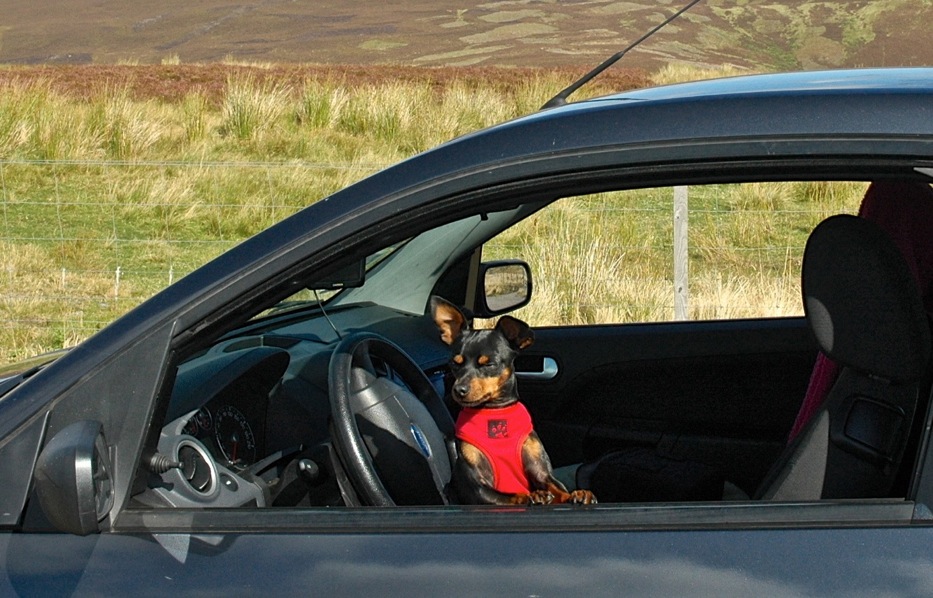
I’m a happy owner of a very curious dog, who loves to explore and does not make a home-sickness 30 minutes after he leaves home. It makes him a great company for my holidays. But even that, there is some things to take into account to make such a travel smooth and enjoyable.
Firstly, your dog has to like it, or at least – if it is just a travel from one point to another- to bear it. I cannot imagine spent one or two weeks of my holidays with a dog hiding from me because he’s sick of traveling. Than, think of the traveling conditions of your pet, whatever mean of transport you take: a car, a plane, a train, a bus or a ferry. If you stay in a hotel or on the camping, check if dogs are admitted. Remember that dogs are not admitted in most of visiting places like museums. Some restaurants as well do not welcome dogs. And don’t forget about dog’s documents, in particular when you travel abroad.
Traveling with a dog by car
It’s probably the easiest way. The biggest problem you can have is that your four-leg friend is afraid of a car (I suppose here that your car is big enough to let in and you and a dog 😉 ). To avoid this – make some short-distance rides to get him (or her) used to a car. To you, it gives an opportunity to observe and learn his behavior.

Don’t forget about safety of your dog. In case of an accident, he runs the same dangers as we do. So, protect him.
The safest way is to make your dog travel in a travel box, however this solution requires a) a place in your car, b) again, some exercises with your dog. Nothing cannot be done for the size of your car, but for the exercises, just put the box at home for some time at let the dog to « use » it. And once in a car, make sure that the box is sufficiently aired. Another way is a seat belt, you can buy it in any shop specialized in animals accessories. However, it is quite rigid and quite short, which gives the best security, but the dog cannot move too much. My dog likes to watch through the window (if not, he becomes unsupportable) so he stays on the seat in a small bed, but on a highway he goes down, behind the seat (nothing to see, I guess). I attach him do a short lead, which is attached on its turn to a seat belt – it provides more a flexible solution, still safe, I believe, hopefully I had no opportunity to verify it yet. Don’t allow your dog travel on your laps – mine loves traveling like this, but I’m afraid he can be injured seriously in this way by the wheel.
On the end, think about regular pauses and have fresh water to offer to your dog.
And never, don’t leave your dog in the car during a very hot or very cold weather – a small environment of the car will increase quickly these conditions, making them dangerous for your animal. ↑
Traveling with a dog by plane
First think to verify if the airlines you are going to take accept the animals. Generally, the regular lines accept dogs, but low cost lines don’t. Small dogs (the airlines may define « small ») can travel in the cabin with you in their travel box (the size of which will be defined by the company as well). Bigger dogs have to travel in the baggage hold in their cage equipped with a water suppli
 er and a bed, maybe something to cover, to keep warm. I saw dogs traveling like this and they didn’t seem to me very traumatized, so, don’t worry.
Another thing, your dog has to have a plane ticket. Yeap. You cannot order it by Internet – the number of animal on the plane is restricted – you can buy it only in ticketing office or by phone. Don’t leave it of a last moment, usually there is some delays which has to be observed. However I don’t know how the pricing is functioning, I had only an opportunity to travel with AirFrance inside of Europe and it cost me a little more than 100 Euros and everything was smooth and easy. Ah, and don’t’ forget about necessary documents – check with airlines and for the specific conditions of country of your destination. ↑
Traveling with a dog by train
Rules concerning traveling dogs by train depend a lot on the type of the train and the country.
Dogs can travel on a board of all trains in France: small dogs in their box for a price of 7€ and bigger ones for a half-price ticket (find more at SNCF). Similar conditions apply to the trains in Poland, except for the prices: nothing for small dog in the travel box, and 15 PLN (about 4€) or 25 PLN (if bought on the board of the train) for bigger dogs (PKP). The same in Germany, dogs are allowed in the trains without a bigger problem. You don’t need to pay for a small dog in his box, and a children fare will be applied for bigger dogs (DB). In Belgium, traveling with a dog is particuliary cheap: 0€ or 2,3€ (SNCB). Special prices and conditions can be applied for night trains. Generally, it is not possible to buy « dog » ticket by internet.
Dogs cannot travel on a board of Eurostar and only small dogs are accepted at Thalys. However, you can take your dog with you when crossing the Channel using the Eurotunnel Shuttle (a fare of 24€ will apply). ↑
Traveling with a dog by bus
Very complicated with a tendency to impossible. Dogs (except for guide dogs) are not accepted at all on the board of Eurolines coaches. Sindbad accepts exceptionally small animals (to some countries only) with a written permission from the carrier for a half-price. ↑
Traveling with a dog by ferry
Easy. Dogs are accepted without any troubles at ferries (at least in Europe). In some cases your friend can accompany you at the deck, however in some cases, he will have to stay in the car. A fare will applied in two cases whatever the size of the dog. Obviously, you have to take care not only about his ticket but the necessary documents. ↑
Traveling with a dog abroad
Living in EU makes us to forget about passports however dogs are not exempted of this duty. Moreover, traveling from and to the countries outside of EU may demand to obey some special requirements.
Inside of EU, a dog has to have an identification microchip or a tattoo and a passport issued by one of the EU countries. This document contains not only the information about your dog, but the information about his vaccinations, in particular, a vaccination against rabies and it can be delivered only after this vaccination completed, it means only for dog which are at least 3 months old. For details check: EU rules, national rules (Europe), US. ↑
All photos by Huskyeyes.net
 Photos, voyages et autres histoires